
How a New Process is a Gamechanger for Rebates and Comfort Complaints
I take great pride in the HERS ratings I performed with Southern Energy Management for the first eight years of my career. They’re a rigorous, nationally recognized standard for a reason. Evaluating the effectiveness of the thermal envelope, testing for leakage, and measuring the efficiencies of major appliances, it was all work that mattered. And the HERS INDEX has given homeowners a reliable way to compare and improve home performance for decades.
But a HERS rating doesn’t fully capture the work that goes into building efficient homes. Notably, a standard HERS rating relies on default values for HVAC installation quality that our home builders are often already exceeding, and for a long time there was no way to measure that added value.
Fortunately, that all changed around four years ago with the introduction of our HVAC Grading service. Now, there’s a way for builders to ensure that the quality of their HVAC installation counts for more, and our builders are already reaping the benefits to both their public standing and their wallets.
What Is HVAC Grading?
HVAC Grading is a structured, five-step quality verification process that confirms your HVAC systems are designed and installed the way they were intended to be. Developed collaboratively by RESNET, Air Conditioning Contractors of America (ACCA), the International Code Council (ICC), and the Environmental Protection Agency (EPA), it evaluates design, duct leakage, airflow, electrical draw, and refrigerant charge, and rewards builders with lower HERS scores which means higher rebate returns.
Step 1: Design Review – Using the Manual J, we double-check the proposed design to make sure the system is appropriately sized.
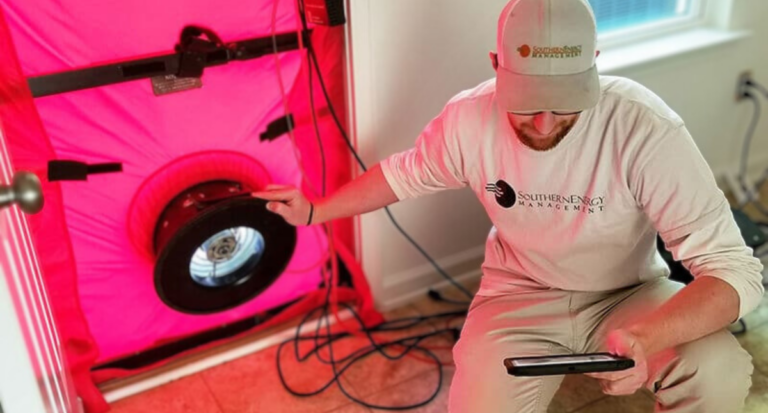
Step 2: Duct Leakage – A Total Duct Leakage Test is part of any HERS Rating, but is also vital for HVAC Grading.
Step 3: Total Airflow Testing – Using a balometer, we make sure the system is circulating air at the rate called for by the design.
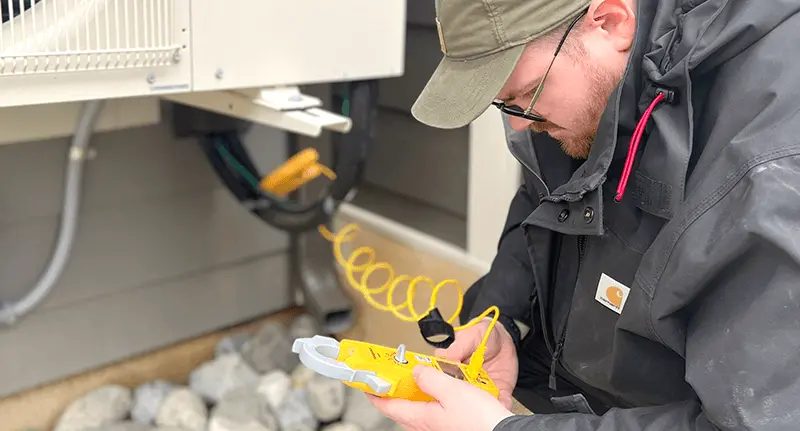
Step 4: Watt Draw Testing – We test the air handler while operating to make sure it isn’t using too much power.
Step 5: Refrigerant Charge Evaluation – Two steps here: either we can verify the correct amount of refrigerant was installed (Weigh-In Method), or we test to make sure the system is providing the correct amount of cooling (Non-Invassive Method).
What We Found in the Field
We weren’t sure what we were going to find when we started offering HVAC grading. There were studies suggesting that 70% of homes had improper airflow, and that anywhere between 57-82% had incorrect refrigerant charge, but those studies were conducted decades ago. How often are modern HVAC installs going wrong?
What we found was that overall builders and HVAC trades are already doing a great job, but that this hard work is not being fully reflected either in their HERS Scores or their rebates.
What Are Builders Leaving on the Table?
HVAC Grading gives you and your home buyers verified confidence that every system was checked before the keys were handed over.
As potential homebuyers are increasingly inundated with viral stories of nightmare homes that are never the right temperature, being able to show your clients that you can guarantee the quality of your home comfort systems makes a huge difference. That kind of assurance is a powerful differentiator in a competitive market that builds strong word of mouth and brand reputation.
The Rebate Math
Natural Gas heating systems get all the benefits of having the quality of their work validated by a third party, and also see increased rebates of around $300-$400/home. But Heat Pumps systems see even greater returns, with average HERS score drops of around eight points, and HERO code rebate from Duke Energy increasing by $1,200/home (Though I’ve personally seen rebates as high as $1,680 on one home). And when you’re building at volume, those rebates add up fast.
Get In Touch For HVAC Grading Services
At Southern Energy Management we understand the special requirements of being in a mixed-humid climate and how that impacts mechanical systems and building performance. Our team has implemented HVAC Grading with over 40 builders across North and South Carolina — from boutique custom builders crafting one-of-a-kind homes in Chapel Hill to national production builders operating at significant scale in regions like Charleston, Greenville, and across Brunswick County.
Whether you’re on the coast in Myrtle Beach, or a part of the booming growth across Raleigh and Durham, we’ve refined our process to fit seamlessly into your construction timeline and subcontractor workflow – regardless of your volume or how complex your floor plans are. We know how builders operate, and we work with your process to meet your needs.
Whether you’re looking to boost your rebate returns, reduce callbacks, or simply deliver a better product, HVAC Grading is a process worth adding. Want to see how much you’d increase your rebates by? Let’s set up a meeting today to talk about and get a free assessment.
Frequently Asked Questions
Q: What are the three HVAC installation grades?
A: Under ANSI/RESNET/ACCA/ICC Standard 310, each step beyond in the HVAC Grading process beyond Design Review is graded on a three-tier scale, with Grade I being the best and Grade III being the worst. If any step along the way results in a Grade III rating, the testing cannot continue.
Q: What’s the difference between HVAC Grading and a standard HERS rating?
A: A standard HERS Rating measures how energy-efficient a home is, accounting for envelope and duct leakage, insulation quality and values, home orientation, equipment efficiency, and other such metrics. HVAC Grading is an additional service which, though not required by RESNET for a HERS rating, can provide a more accurate picture of total home efficiency.
Q: Do my HVAC subcontractors need to be trained or certified for this?
A: No — your subs don’t need any special certification. Southern Energy handles the grading inspection as part of our process. However, we will require the Manual Js from you HVAC providers in order to complete the design review, and some additional documentation regarding refrigerant installation may be required for the full grading during the colder months.
Q: How long does the HVAC Grading inspection take?
A: Typically 1–2 hours per home, depending on system complexity. We work to schedule it alongside other inspections when possible to minimize impact on your build schedule.
Q: Is HVAC Grading required for any builder programs?
A: HVAC Grading is an accepted pathway for meeting ENERGY STAR new homes under section 5. Heating & Cooling Track A, which means it can replace the Track B traditional pathway for builders pursuing ENERGY STAR certification. However, even if builders are pursuing Track B, HVAC Grading still directly improves HERS scores, which can improve the odds of certifying for both Energy Star and other performance-based rebate programs, such as Duke’s HERO code and Santee Cooper’s Smart Energy Existing Homes (SEEH) Rebate Program.
Q: Does HVAC Grading apply to existing homes, or only new construction?
A: Our HVAC grading service is designed for new construction. It’s most impactful (and cost-effective) when the system is being installed for the first time. Catching installation issues before the homes close is much cheaper than discovering comfort complaints after closing.