Ready to Get Started?
Schedule a free assessment to learn more about solar power & battery storage for your home.
Whether you’re fed up with rising utility bills or ready to power your home or business with clean, reliable energy — it’s time to start your solar journey!
With the 30% federal tax credit set to expire for homeowners after this year, and limited-time incentives like Duke Energy’s PowerPair program, North Carolina residents, businesses, and nonprofits have a rare opportunity to stack incentives and cut solar costs by thousands.
Below, you’ll find a quick breakdown of the top solar incentives available in North Carolina this year, and how to make the most of them before they’re gone.
Upfront Tax Disclaimer
We are not tax professionals (surprise!) and this post does not constitute professional tax advice or guidance. If you end up going on your solar journey with us, we can connect you with Lucas Tax and Energy, a CPA specializing in energy related tax issues, that we keep on retainer as a service to our customers.
If you’re considering solar for your home in North Carolina, now is the time to act. The 30% Federal Solar Investment Tax Credit (ITC) ends for residential systems after December 31, 2025, making this your final opportunity to secure maximum savings.
When paired with Duke Energy’s PowerPair Incentive and other local programs, the savings can be substantial. For an average 8.5 kW home solar system with one battery, customers can expect to save roughly $19,500 off the average turn-key price of $35,000 when combining federal and local utility incentives.
Duke Energy’s PowerPair incentive provides up to $9,000 in incentives for new solar + battery installations. This is a one-time incentive and spaces are limited, customers are selected first come, first served.
Even better? PowerPair can stack with the 30% Federal Tax Credit, helping many homeowners cut their total system cost in half.
This incentive is first-come, first-served, so it’s important to act quickly. If you’re interested, don’t wait! We’ll help you get all your ducks in a row before space runs out. 🦆
Duke Energy offers ongoing bill credits when you enroll your battery in their Battery Control Program, called Power Manager (DEC) or Energy Wise (DEP). Programs allow limited remote control (e.g., during peak demand), while still keeping a safe minimum charge in your battery.
This program is available to both existing and new solar + battery customers (outside PowerPair eligibility).
This program also has limited capacity. There is space left for Duke Energy Carolinas customers. However, capacity is full for Duke Energy Progress customers. Both Duke Energy Carolinas and Duke Energy Progress customers can still take advantage of the $9,000 PowerPair incentive though!
The Battery Control incentive can be applied to multiple solar batteries, but the total combined incentive is capped to a residential interconnection limit of 20 kW. So the maximum incentive you could receive would be $91 a month or $1,092 annually.
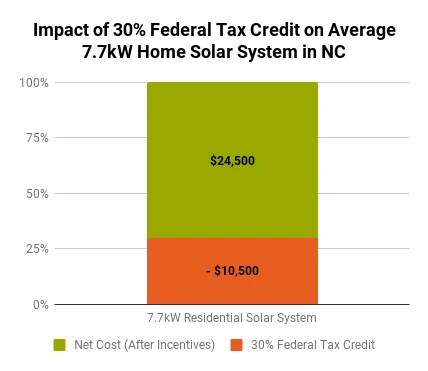
Homeowners who install and commission their solar system by December 31, 2025 can claim 30% of system costs as a federal tax credit.
This means, for an average $35,000 solar system a homeowner can claim a $10,500 credit when filing their 2024 taxes. In this example, if they owe $11,000 in taxes, they will only need to pay $500 in taxes after claiming the solar ITC ($11,000 – $10,500 = $500).
Example: A $35,000 system = $10,500 tax credit; if you owe $11,000, you pay just $500—and any unused credit can carry forward.
There’s no cap on the value of the system, but eligible expenses include:
*Note: energy efficiency upgrades are not included on the above list! We have seen several solar companies try to include items like insulation, LED bulbs, smart thermostats, etc. as a solar system upgrade. These items are not eligible for the solar ITC.
There is NO state solar tax credit for North Carolina, so be cautious if you see that listed on a proposal. Your biggest solar savings opportunities in North Carolina are:
Work with a trusted installer to ensure transparency and accuracy on pricing and program availability.
There are powerful solar incentives available to North Carolina businesses in 2025. When timed right, these programs can help reduce solar costs by 40–70%, and in some cases up to 90% (especially when USDA REAP funding is available).
Some incentives are time-sensitive and will begin phasing down after 2025, so planning early is key.
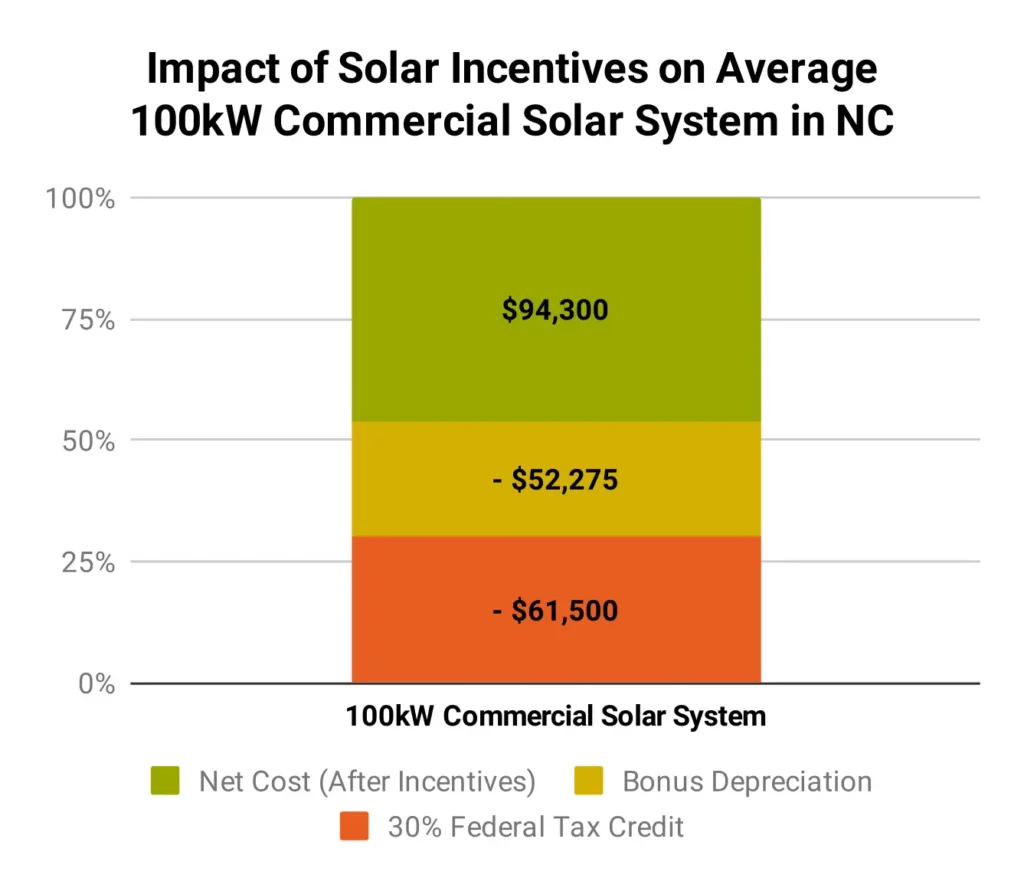
Businesses that install solar systems can claim 30% of their system cost as a dollar-for-dollar tax credit on federal taxes. There is no cap on system size.
Safe harbor rules apply:
Bonus Adders may increase your credit:
Example:
A $205,000 solar system = a $61,500 credit
Net cost: $143,500 (before depreciation, adders, or grants)
More information about the Federal Tax Credit can be found on DSIRE.
Thanks to recent tax law changes, 100% bonus depreciation is back for qualifying solar equipment placed in service in 2025.
This allows your business to write off the entire depreciable basis of the system in year one, on top of the solar tax credit.
More information about bonus depreciation can be found at DSIRE: MACRS Depreciation.
At this time, Duke Energy does not offer commercial solar incentives, including through the PowerPair program (which is residential-only).
We’ll update this section if a new commercial incentive becomes available.
The USDA Rural Energy for America Program (REAP) Grant provides grants and loans to farmers and businesses for renewable energy projects, energy efficiency upgrades, and energy audits. As of now, the REAP grant is currently set at a 25% award, with applications being accepted twice a year in the Spring and Fall. To qualify for the USDA REAP Grant, you must be an Agricultural Producer or Rural Small Business.
Recent Updates
While a 50% boost was briefly available under the Inflation Reduction Act, that higher funding is currently paused due to high demand and limited funds. There’s a possibility it could return in future funding rounds, but nothing is guaranteed.
⏳ Plan for at least a 9-month process. Apply early to align with spring or fall deadlines.
Eligibility:
Individual or entity directly engaged in agricultural production whereby 50% or greater of its gross income is derived from agricultural production.
An entity or utility that meets the Small Business Administration’s (SBA) Small Business Size Standards by the North American Industry Classification System (NAICS) found in 13 Code of Federal Regulations (CFR) Part 121.
More information about the USDA REAP Grant can be found at DSIRE.
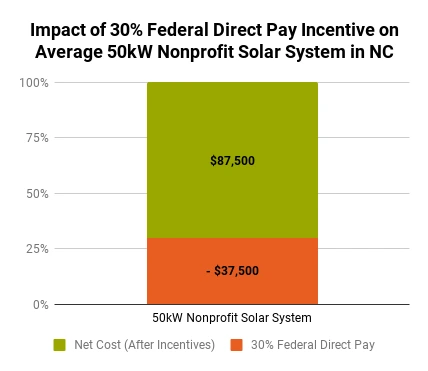
Thanks to the Inflation Reduction Act, nonprofits and government organizations can now access the 30% Federal Solar Tax Credit through Direct Pay, meaning they receive a cash reimbursement from the IRS after the system is installed and placed in service.
Historically, nonprofits & government organizations were not eligible for the 30% Solar Investment Tax Credit (ITC) since nonprofits do not have tax liability. However, the signing of the Inflation Reduction Act (IRA) expands the 30% incentive to include nonprofits and government organizations through a Direct Pay Reimbursement. This is huge news in the solar world, and opens up many more opportunities to expand solar across nonprofit and government-owned roofs!
📅 Systems must be in service by December 31, 2027 to qualify for the full 30%, subject to the same safe harbor rules as businesses.
Pheeeeeeew…congrats, you made it to end!
There are many reasons to go green, and several incentives that will save you even more. Going solar is a big decision, with a big reward. Let us know how we can help you tap into solar incentives and take control of your power this year.
Residential ・ Commercial
Available to homes and businesses, the Federal Solar Tax Credit is a tax credit that you can claim for installing a solar or battery system on your property and is worth 30% of system costs.
Nonprofit ・ Government
Tax-exempt, nonprofit, and government organizations can now tap into solar cost savings through a Direct Pay reimbursement, worth at least 30% on system costs.
Farms ・ Rural businesses
The USDA REAP program provides grant funding to farms and rural businesses for solar energy systems to help permanently reduce operating expenses. When combined with other incentives, eligible farms & businesses can save 70-90% on the cost of solar with a REAP Grant.
Schedule a free assessment to learn more about solar power & battery storage for your home.
North Carolina’s solar power and building performance expert. Founded in 2001, we’ve worked for 20+ years to improve the way people make and use energy.