What is the DOE Zero Energy Ready Home Program?
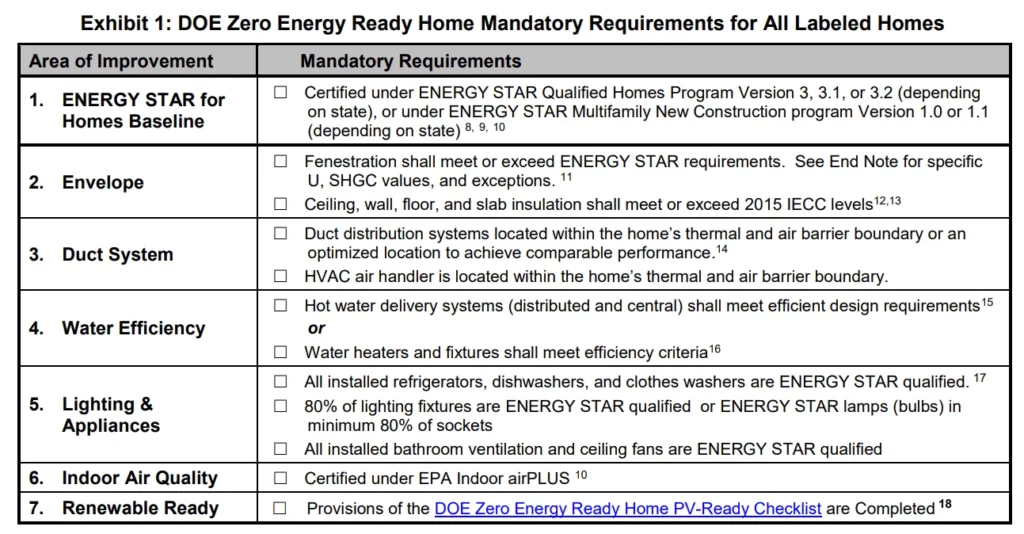
Going above and beyond the ENERGY STAR program, the Department of Energy’s Zero Energy Ready Home (DOE ZERH) Program represents a new level of performance in building energy efficiency, comfort, health, and durability. In a nutshell, DOE ZERH builds stricter requirements on top of the ENERGY STAR Certified Homes and Multifamily New Construction programs, by adding EPA Indoor airPLUS certification and demonstrating PV-Readiness as qualifications.
Why should you be interested in DOE ZERH?
There are several incentives for multifamily builders and developers that require a project to be DOE ZERH certified:
- Inflation Reduction Act (IRA) 45L Tax Credit: includes a $1,000 per unit incentive for multifamily projects with ENERGY STAR Multifamily New Construction (MFNC) + DOE Zero Energy Ready certification.
- $5,000 per unit incentive for multifamily projects with ENERGY STAR MFNC + DOE Zero Energy Ready + Prevailing Wage
- Virginia’s Housing Innovations in Energy Efficiency (HIEE): funding requires DOE ZERH certification for affordable housing new construction projects.
- The HIEE program will offset 10% of Total Construction Costs (TCC), up to $2 million.
What is required for DOE Zero Energy Ready Home Certification?
DOE ZERH Requirements
HERS/ERI Target
The reference ‘Target Home’ for DOE ZERH has higher specifications when it comes to HVAC equipment, insulation, air infiltration, windows, and water heater.
The specifications in the table below are not necessarily a prescriptive list, but rather, what your design will be compared to in terms of its Energy Rating Index (or HERS score). In other words, you can trade off one component (e.g. cooling efficiency) for another (e.g. U-value, insulation levels, etc).
Example for Mixed Climates (Climate Zones 3 & 4 except Marine)
| Component | DOE ZERH Target Home |
|---|---|
| Heating & Cooling | 15 SEER / 9 HSPF |
| ASHRAE 62.2 Mechanical Ventilation | 2.8 cfm/W |
| Insulation | 2015 IECC |
| Infiltration | 2.5 ACH50 |
| Windows (U value & SHGC) | U-value: 0.30 Solar Heat Gain Coefficient: 0.25 |
| Water Heater (electric system in an attached dwelling) | Energy Factor = 1.5 |
| Appliances (dishwasher, refrigerator, ceiling fans, lamps/bulbs) | ENERGY STAR Certified |
Indoor airPLUS
Indoor airPLUS is a voluntary partnership and labeling program that helps new home builders improve the quality of indoor air by requiring construction practices and product specifications that minimize exposure to airborne pollutants and contaminants.
The program builds on an ENERGY STAR certification and has its own set of requirements summarized in a verification checklist. Southern Energy Management is able to provide the verification and certification services needed to get Indoor airPLUS certified.
PV-Solar Ready
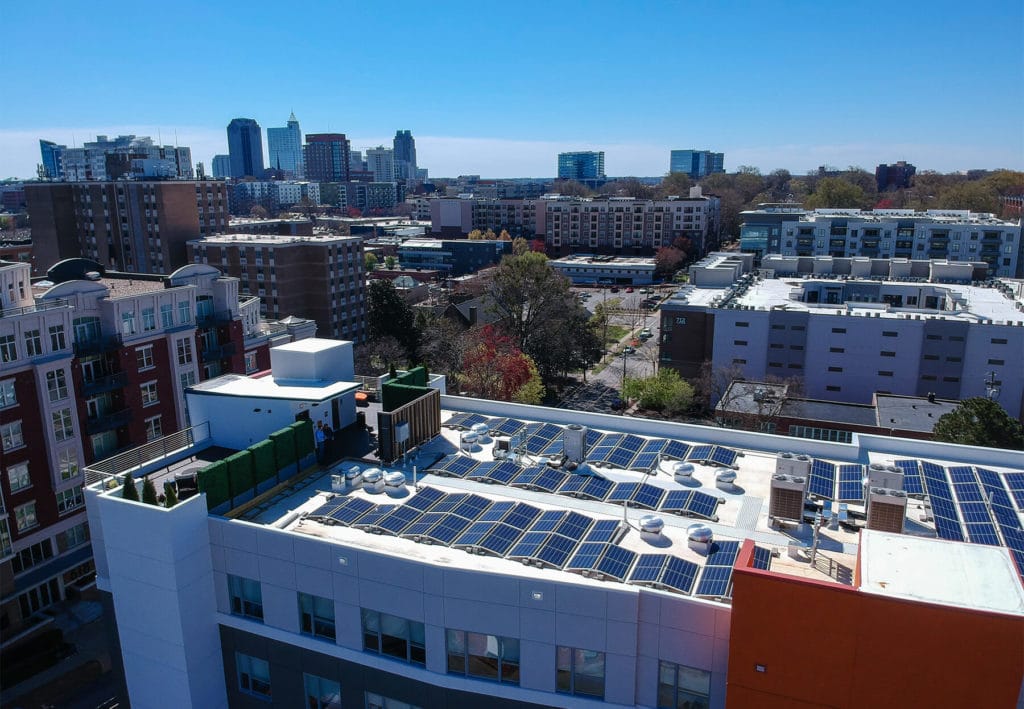
The “zero energy ready” part of the program’s name comes in part from the requirement for projects to lay the foundation – with necessary framing, electrical components, and roof area – for installing PV solar panels at a later time. For multifamily buildings, the checklist applies to electrical loads related to common spaces (not residential units). The PV-Ready Checklist also needs to be completed as part of the DOE ZERH certification.
Let us help you!
Are you curious to know what it would take for your multifamily new construction to meet the DOE ZERH requirements? We can help by assessing your existing plans and listing the upgrades needed. Give us a call today to get started →